
Terawulf Appeals Explanations (As We Understand Them)
A deeper dive into the appeals that will be discussed at the upcoming meeting.
Zoning Board of Appeals Meeting: Tuesday, December 16th.
Public hearings on both appeals will be held. This will be our chance to express our opposition to TeraWulf’s zoning appeals. If you can't make it in person on the 16th, send your comment to TOLcodes@lansingtownny.gov before the 16th to have it forwarded to the ZBA members.
We need to make our voices heard that we do not think the ZBA should accept Terawulf's appeals. We’ve prepared the following pages about our thoughts regarding the appeals as a starting point for formulating your comments.
The CEO’s interpretation: Laboratory
The Code Enforcement Officer’s conclusion is that a laboratory and data center are different things. According to §270-8 of the Town Code, uses not listed as permitted are not allowed. Therefore, TeraWulf’s proposed use of “Data center facilities - high computing and AI," as found in the site plan, is not permitted.
Definitions used by the CEO
“Laboratory” is defined by §270-3 of the Zoning Code as “a building or group of buildings within which are located facilities for research, investigation, testing or experimentation, but not facilities for manufacturing or selling products except as may be necessary for prototype development or as incidental to the main purpose of the laboratory.”
“Data center” is defined by Wikipedia as “…a building, a dedicated space within a building, or a group of buildings used to house computer systems and associated components, such as telecommunications and storage systems.”
“Data center” is defined by Amazon Web Services as “…a physical location that stores computing machines and their related hardware equipment. It contains the computing infrastructure that IT systems require, such as servers, data storage drives, and network equipment. It is the physical facility that stores a company’s digital data.”
“Data center” is defined by the American Planning Association (APA) as “a physical; facility that houses servers, storage, and networking infrastructure to support digital applications and services.”
From TeraWulf’s appeal to be a “Scientific Research Laboratory”
TeraWulf argues that the Code Enforcement Officer incorrectly treated the term “data center” as a distinct unlisted use. They then compare the Town Code’s definition of Laboratory (§270-3) to the Merriam Webster definition of data center:
“Factilities for research, investigation, testing or experimentation”
- Lansing Town Code, §270-3
“a facility used to house computer systems and associated components, such as telecommunications and storage systems.”
- Cited as a Merriam-Webster definition
TeraWulf argues that by its nature, a facility by that definition supports the processing, storage, and analysis of data—activities integral to research, investigation, testing, and experimentation. Therefore, a data center used for research computing qualifies as a laboratory.
What TeraWulf leaves out
TeraWulf only quoted part of the Town Code definition of “Laboratory” in their appeal. The full definition includes “but not facilities for manufacturing or selling of products” in it. It could be argued that because TeraWulf is selling their GPU processing power, that could be considered to be a “product” they are selling.
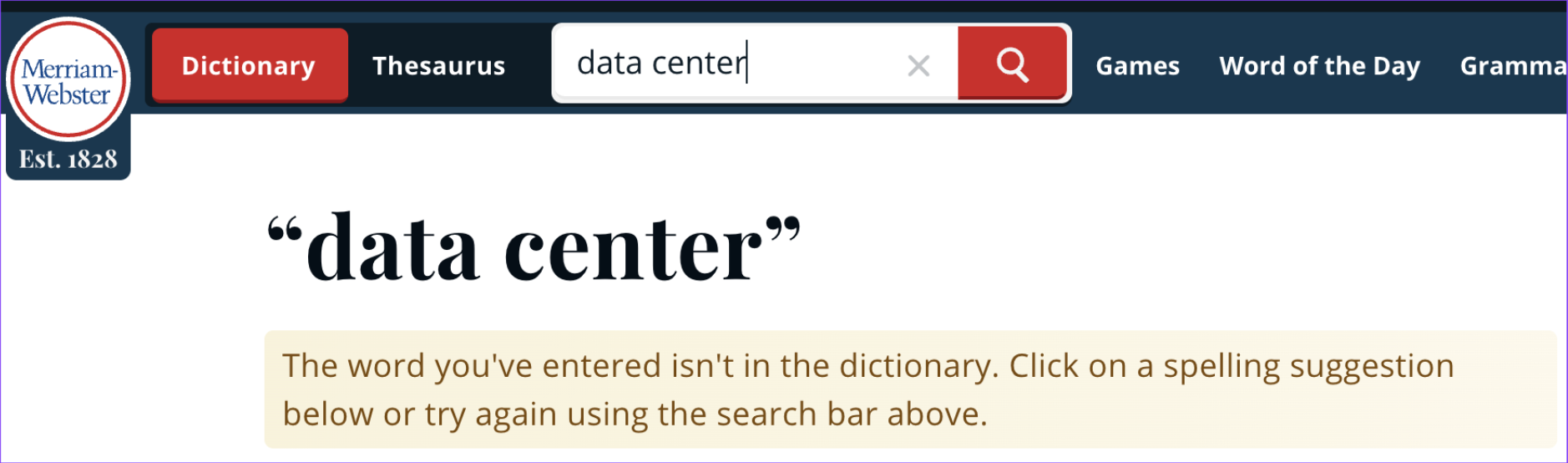
TeraWulf also references a Merriam-Webster definition of “data center” that is not in the dictionary. The Code Enforcement Officer cited definitions of “data center” from AWS, Wikipedia, and the American Planning Association, probably due to the absence of it in the dictionary.
This appears to be the first time TeraWulf is positioning themselves as a scientific research laboratory, seemingly for the purposes of manipulating the code interpretation in their favor.
As previously posted by us on 12/8, there is video evidence of TeraWulf CEO Paul Prager stating that he “has no idea” what TeraWulf’s partners like G42 do with the GPUs or data they gather while using their facilities. Additionally, CSO Kerri Langlais states that TeraWulf is an energy infrastructure company, not a technology company, and other companies control the GPUs.
“The Cayuga data campus is designed as a multi-tenant infrastructure, meaning it provides power, cooling, and secure space for other organizations’ computing equipment. The operator (TeraWulf in this case) manages the physical environment and connectivity, not the data itself” - From the Independent Assessment document
Based on TeraWulf’s CEO and CSO’s statements, as well as the Independent Assessment’s description, TeraWulf is not responsible for and does not control the data/contents of the GPUS. Therefore, TeraWulf should not be able to claim that the GPUs are for science and research.
The CEO’s interpretation:“Warehouse” or “General Processing”
The CEO’s conclusion is that TeraWulf’s data center is not premitted. It’s not defined by the town code, and therefore not allowed (§270-8). TeraWulf’s submission for a “general processing and data warehouse” or “modern research technology campus” from their site plan application from October 29th is not consistent with their September 9th application.
The multiple references in the October 29th application calling out the structures as “data centers” contradicts the “General Processing and Data Warehouse” use. The information provided on TeraWulf’s website is also contradictory to the use.
In addition, the Industrial/Research District specifically allows light manufacturing, fabrication, assembly, or research. A 138MW facility (with plans to expand to 400MW) does not match this criteria.
TeraWulf’s Appeal: “Warehouse” or “General Processing”
TeraWulf claims they are not asking the Board to recognize a new, unlisted use. TeraWulf seeks a determination that the proposed use is permitted under categories already present in Schedule I (a document specifying Land Uses or Activities), and that §270-8 of the Zoning Code does not apply.
TeraWulf says that it was explained in the October 29th application that the project involves the processing of research data through continuous computational operations and the storage of that data within enclosed facilities. They argue those activities correspond directly to the ordinary meaning of “General Processing” and “Warehouse/Storage of nonagricultural goods,” both of which are permitted in the IR District.
They also argue the word goods in “Warehouse / Storage of non-agricultural goods” is undefined in town codes. Nothing in the Town Code confines goods to physical objects. They also claim that no limits can be put on what is considered to be “light manufacturing” since there currently isn’t an existing limit.
According to the NYS Dept. of State Local Government’s “The Zoning Board of Appeals” Guidance
“Where there are no prior decisions to rely on, the board of appeals should attempt to determine the governing board’s original intent in enacting the provision in question. In arriving at this determination the board should consider prior documentation such as: minutes of governing board meetings; testimony of local officials; and planning advisory documents which may have accompanied the enactment.”
The Zoning Board of Appeals must determine what the original intent of “light manufacturing, fabrication, assembly, or research,” “general processing,” and “goods” was meant to be when zoning was written in 2003. We cannot allow TeraWulf to manipulate the definitions to make their data center fit in with our codes.
Neither Appeal is a Good Fit
We’re not lawyers or land-use experts, but it’s clear to see that TeraWulf’s appeals to be classified as a “Scientific Research Laboratory” or “General Processing” and/or “Warehouse / Storage of non‑agricultural goods” are not a good fit for the Industrial/Research District.
We need to provide comments highlighting the mismatch between TeraWulf’s operations and their appeals for their classification at the December 16th meeting.
We recommend reading pages 3-15 and 481-490 of the Agenda Packet on your own prior to the two public hearings. There’s much more material that hasn’t been covered in this short summary. We only summarized what we found to be the most impactful pieces of the appeals packet.
