
E-waste and Noise Pollution Concerns
Why we oppose a new AI Data Center in Tompkins County: Mini Series Part 2
Short Lifespan of Materials
The lifespan of GPUs working 24/7 to compute AI models is roughly 1 to 3 years, according to an Alphabet specialist. GPUs contain precious earth metals which are ideally recycled to their fullest capacity but the remaining infrastructure is typically wasted. According to the Geneva Environment Network, the global recycling rate for e-waste is only 20%.
Depending on the adoption rate of generative AI, the technology could add 1.2 million tons to a total of 5 million metric tons of e-waste by 2030, according to a study published in 2024 in Nature Computational Science.
E-waste Impacting the Environment
E-waste is bad from an environmental sustainability perspective because dangerous compounds inside data center equipment can leach into the natural environment, potentially harming plants, animals, and humans. It can also negatively impact people in foreign countries, which often become the final destination for discarded IT equipment.
The Geneva Environment Network says, “E-waste can be toxic, is not biodegradable and accumulates in the environment, in the soil, air, water and living things”
TeraWulf’s Previous Noise Pollution
TeraWulf claims that the noise from their planned data center (55db) would stop at the propety line, however, sound travels much further on lakes than land and it does not stop at property lines.
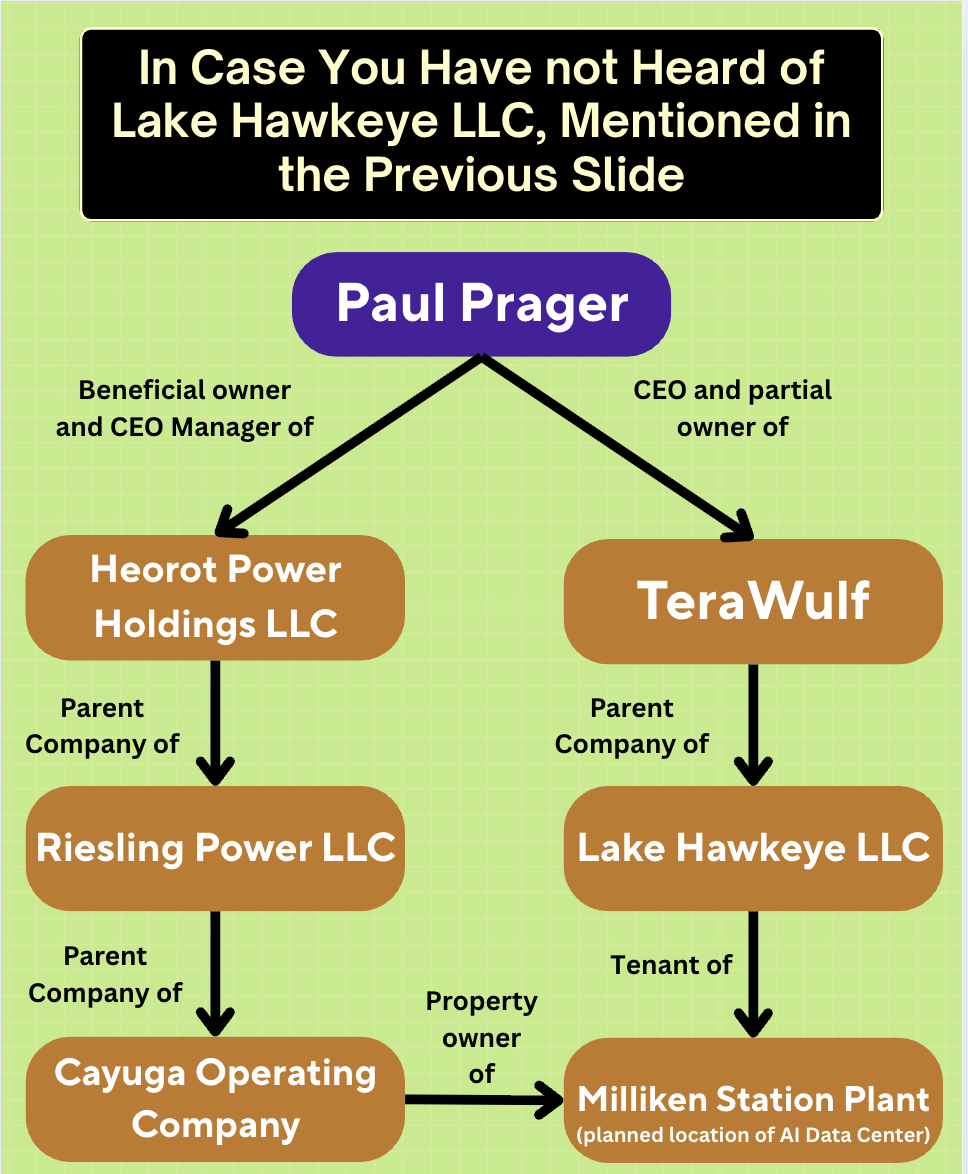
There have been reports of noise issues at TeraWulf’s facility in Somerset, NY. TeraWulf claims this is only due to Bitcoin mining, but there are documented noise complaints for AI data centers without Bitcoin mining all across the nation. Additionally, in the 80 year lease between Lake Hawkeye LLC and Cayuga Operating Company, crytocurrency mining is a permissible use. They have verbally said they will no longer mine bitcoin, but we need this in formal agreements with the Planning Board before we can be convinced.
Noise Pollution Impacts on Birds
Based on a 14 year long study in North America, researchers concluded: “Considering the impacts of noise pollution, researchers found that increased noise in forests meant songbirds nesting there laid fewer eggs and were less likely to successfully raise all of their chicks. Human-generated noise could be affecting male mating songs, especially in forests where they tend to sing at lower pitches. The female birds could have more difficulty hearing male bird songs through low-frequency human noise.”
Chronic low-frequency noise (50–70 dB) travels well over water and causes herons to abandon their feeding sites and rookeries. It is important to note that only a few miles south on Cayuga Lake, dozens of herons have been observed roosting at night.
We Have the Ability to Slow Down the Current Unregulated AI Boom by Rejecting TeraWulf’s Development in Lansing
Data centers have a proven history of negatively impacting local communities that surround their facilities. The technology and infrastructure companies also seem to lack empathy for communities impacted by the e-waste their businesses produce.
It is our duty to be informed about these big-picture topics related to AI and make the right decision for our community and for our lake.
Follow along this week for more of our mini series.
